

On September 12, 2017, Jamie Dimon stood on stage at CNBC’s Delivering Alpha conference and called Bitcoin “a fraud.” Worse than tulip bulbs, and anyone who bought it was “stupid.”
Today, JPMorgan moves more than $2 billion a day in tokenized dollars on its own blockchain, and is building a shared stablecoin network with three of its largest rivals.
To clarify before we start, the banks are not trying to kill stablecoins, they know they can’t. They’re trying to seize the business entirely, absorb the innovation, and shut the gates on fintech.
If you’re building in the stablecoin space, this is the most crucial context you need on your biggest competitors. This is the roadmap for the next 24 months of the bank-versus-stablecoin fight.
If you don’t take this threat seriously, you will after reading this article.
We spent months studying every major banking disruption of the last fifty years: the money market fund, the internet bank, PayPal, and the fintech wave.
We were looking for the pattern in how banks respond to threats. It always works the same way, running in six distinct stages. We have identified the stages and created a playbook that you can follow to anticipate their next move.
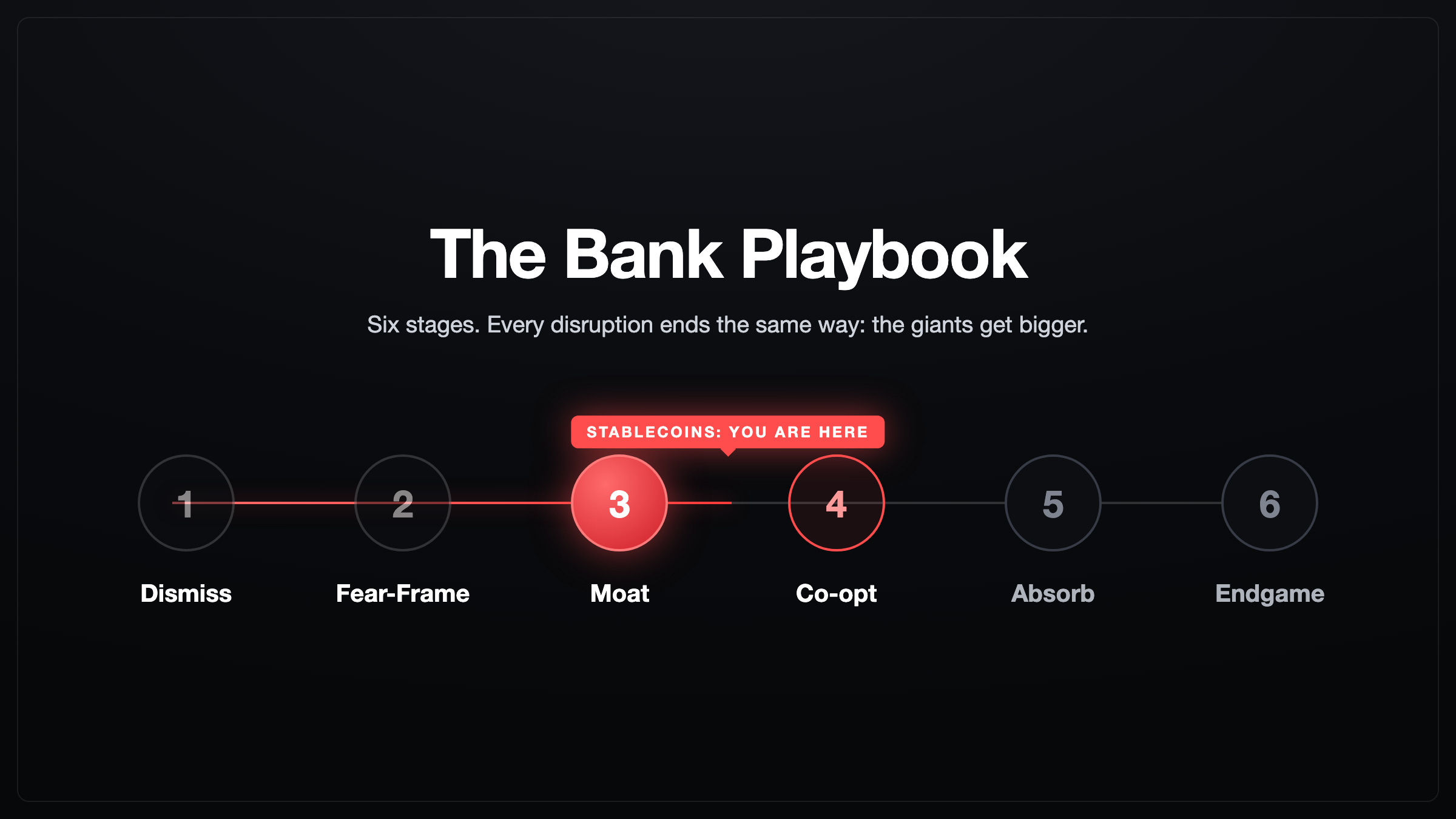
Several times in the last fifty years, a new technology was supposed to end banking. In each case, the banks countered it and came out stronger. Banks never compete on technology. Instead, they weaponize regulators against innovators or use powerful lobbies to grind progress to a halt.
Stablecoins are next on their list. The banks are already halfway through the same script.
Here is that script, stage by stage. Each stage has happened before, repeatedly. In this article, we break down those events in minute detail. Then we show how it is repeating in stablecoins, where we are now, and what could finally break the streak.
Stage #1: Dismiss and Ridicule
The game starts with a subterfuge. The most powerful people in finance go on television and laugh at it.
It is the opening move in every case we studied:
Money market funds (1970s). When funds began paying interest rates at double what banks were legally allowed to, the banks called them a gimmick that would not survive a rate cycle.
Ecom Banking (early 2000s). Waved off as a toy only useful on eBay, until PayPal launched an MMF.
Fintech (2010s). Bank executives scoffed at fintech as they frequently went on record, stating they could never handle risk, AML laws, or compliance.

The ridicule is a good early-stage lever. It is cheap, it scares away talent and capital, and it buys time. But it always runs alongside an internal study, measuring the actual threat level.
Now watch the exact same move, with the onchain dollar:
Jamie Dimon, September 12, 2017: Bitcoin is “a fraud,” “worse than tulip bulbs,” and buyers are “stupid.”
Larry Fink, October 2017: Bitcoin is “an index of money laundering,” the domain of “money launderers and thieves.”
Warren Buffett, May 2018: Bitcoin is “probably rat poison squared.” Charlie Munger called the investors “idiots” and the asset “disgusting.”
But look at what they did instead of what they said.
JPMorgan shipped its first tokenized-dollar product, JPM Coin, in February 2019, while Dimon was still calling the industry a fraud. It is now called Kinexys, it has processed more than $1.5 trillion, and it clears over $2 billion a day.
By 2024, Fink’s BlackRock ran a Bitcoin ETF and the largest tokenized money market fund on the market, and Fink was calling Bitcoin “digital gold.”
They use dismissal as a cover to frontrun any serious competitors.
We’ve all seen this play in real time; this stage is over for stablecoins.
Stage #2: Fear-Frame and Invite the Regulator
When a technology can no longer be laughed off, the banks move on to the next strategy. They start calling it a threat, a threat to the public, to the system, to market stability.
The best historical parallel is the money market fund, it was the same fight over yield, four decades ago.
Wall Street introduced MMFs in the 1970s paying 9%-17% in interest, much higher than what banks were legally allowed to pay.
Between 1977 and 1982, MMFs saw their AUM balloon from $4B to $230B, while banks experienced one of their worst period of deposit outflow.
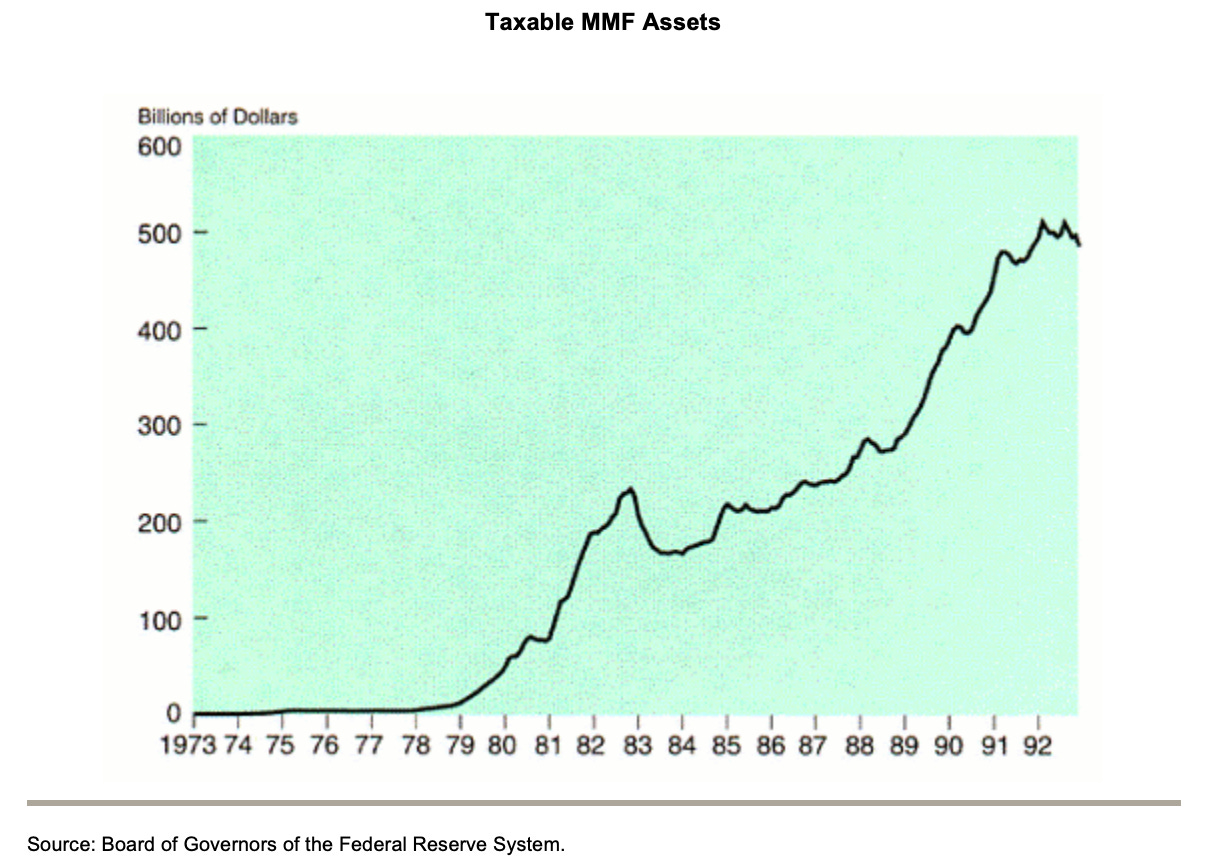
After failing to persuade the regulators to restrict money funds, they went to Congress in 1982 to pass the Garn-St Germain Act. This lets banks offer a new kind of savings account (MMDA, Money Market Deposit Account) with an uncapped interest rate.
The banks matched the interest rate the MMFs were paying, and these accounts were FDIC insured on top. Since MMFs could offer no such guarantee, deposits soon flew back to banks.
Now take a look at the 2026 headlines:
May 8, 2026. The Bank Policy Institute, the lobby for the largest banks,
publishes “Yield-Bearing Stablecoins Can Destroy Deposits.” It projects $3.7 trillion in destroyed deposits and a $2.7 trillion drop in lending.
December 2025. The American Bankers Association and 52 state associations
warn Congress that “trillions will be displaced from community lending.”
January 12, 2026. The ABA and seven more associations cite a Treasury estimate that $6.6 trillion in deposits could be at risk. The community banks run paid advertisements.
January 2026. PNC CEO Bill Demchak says stablecoins “must choose: be a payment tool or a money market fund.”
May 29, 2026. Jamie Dimon, on Fox Business: “The banks will not accept it that way.” Stablecoin rewards, he says, let issuers “effectively pay interest on deposits without protection.” And then: “it will eventually blow up.”

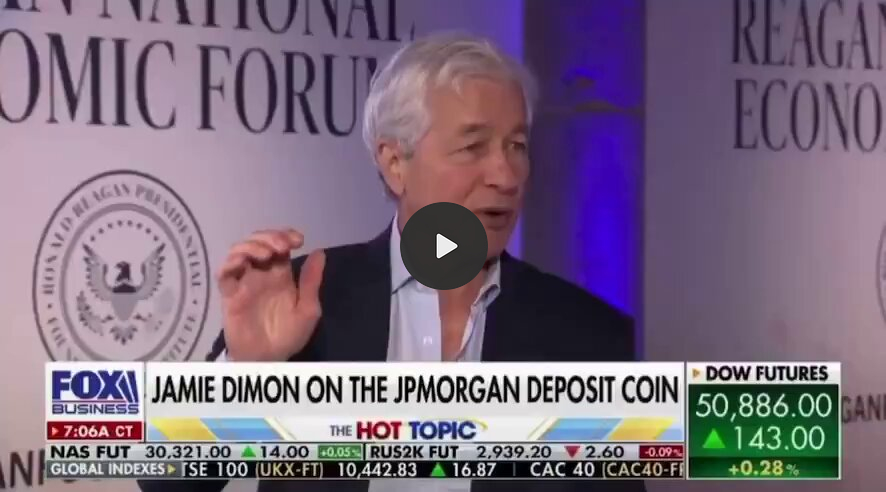
The danger is always framed as a danger to the consumer, the community, and the economy. Never to the bank’s cheapest source of funding.
Their goal is not to be right. They only need to cry wolf loud enough to get the regulators in the room.
Stage #3: Build the Regulatory Moat
Once the regulators enter the room, the job is half done for banks. These are a few examples of how banks use regulators to kill competition.
Money funds got re-regulated on banks’ terms. After the Reserve Primary Fund broke the buck in 2008 (they held $785 million of Lehman’s short-term debt), the SEC forced institutional funds onto a floating NAV. It killed any advantage the MMFs had over banks.
The fintechs that were supposed to replace banks had to become the frontend. The banking lobby put enormous pressure on the regulators, calling fintech “shadow banks” that need to be regulated, making it nearly impossible to get charters. As a result, today, Cross River hosts Affirm and Coinbase. Celtic/Sutton hosts Square. Stride is behind Chime.
The charter is unreachable: The OCC in 2018 tried to create a special National Fintech Charter. This would have allowed fintech startups to get a single federal license to operate across the entire United States without needing to partner with a traditional bank. It was a massively unpopular proposal to NYDFS and other state regulators.
They sued and ran out the clock until the new administration came in and abandoned the program.
Walmart and Rakuten tried to bypass the traditional banking system by applying for their own specialized banking charters. Seeing this as an existential threat, traditional banks deployed their two most powerful lobbies, the BPI and the ICBA, the same lobbies that fight stablecoin yield today.
Both Walmart and Rakuten were forced to withdraw their banking applications.
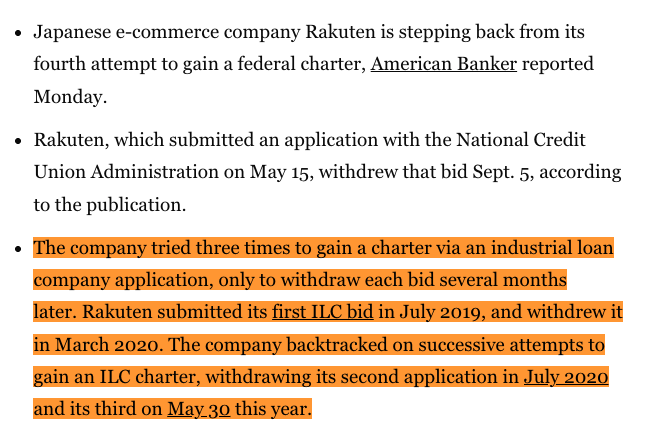
Through their repeated success, banks have learned that they don’t have to beat the product if they can simply block the license.
The target now is the GENIUS Act. Look at the provisions carefully: compliant 1:1 reserves, regular audits, freeze-and-seize, and a ban on issuers paying yield.
Most of these rules don’t apply to banks.
Even if these compromises seem fair today, you have to remember the law is not in effect yet.
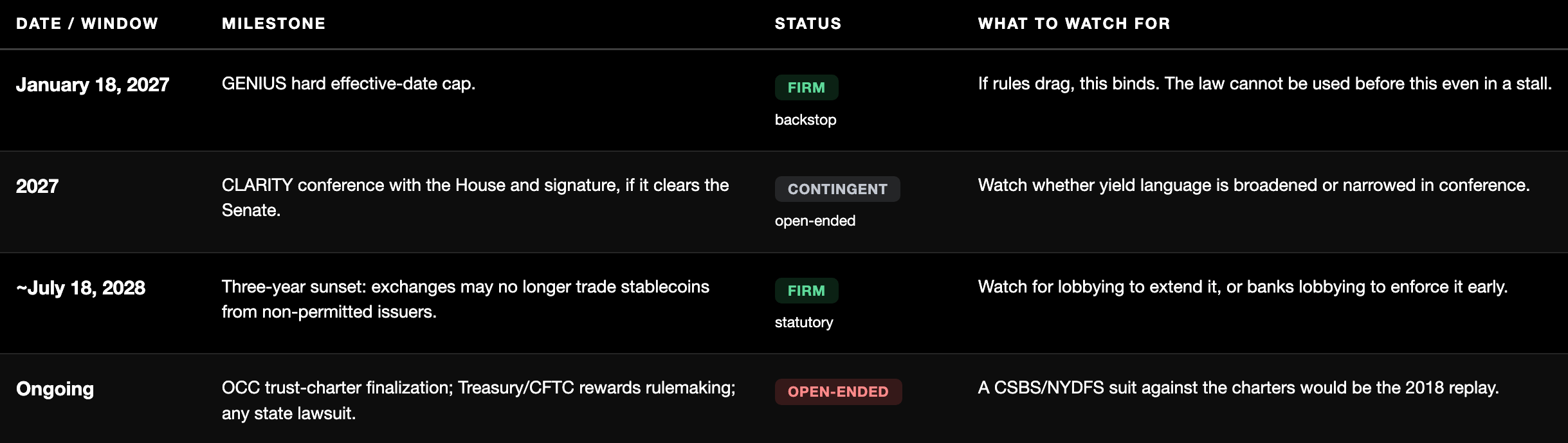
Signed July 18, 2025. It takes effect on the earlier of two triggers: 18 months after signing, a January 18, 2027 deadline, or 120 days after the OCC, Fed, and Treasury issue final rules.
Those rules are not final. The OCC proposed its version in March 2026, FinCEN and OFAC in April. Until they finish, no “permitted payment stablecoin issuer” can exist. The license as prescribed by the law cannot yet be applied. And the banks are trying, with all the efforts they can muster, to delay this process and push through as many last minute changes as possible.


The banks can have a significant influence on shaping the enforcement rules. Every month of delay is a month of uncertainty for stablecoin businesses.
Then there is the most hated word: yield.
The statute bars the issuer from paying it. Non-interest-bearing deposits are historically close to a third of bank funding and the cheapest money a bank holds.
This is the 1982 deposit-account fight in reverse. Then, banks won the right to pay yield to keep deposits. In 2025, they won a rule banning the disruptor from paying it. They somehow always win.
The whole war is now concentrated on a single line in the CLARITY Act: should the ban extend to anything that looks like an incentive? As per the current wording, rewards paid by exchanges are still safe. But not if the banks can help it.
The ABA and the bank lobbies are going to great lengths to ban yields/rewards/incentives/loyalty programs, activity-based or not.


Quick Overview on CLARITY Act’s Progress:
The House passed its version of the Clarity Act on July 17, 2025, 294 to 134.
Senate Banking advanced its text May 14, 2026, 15 to 9, after a compromise: yield banned on idle balances, but activity-based rewards allowed.
Still ahead: merge with the Senate Agriculture bill, survive a 60-vote floor, reconcile with the House.
The yield ban is only one front. The other one is the bank charter.
The OCC granted national trust charters to Circle, Paxos, BitGo, Fidelity, and Ripple in December 2025. The BPI expressed its dissatisfaction immediately and is allegedly in the process of filing suits against the OCC. To be clear, these charters are effectively empty as they can’t take deposits or lend money and have no Fed master account. Without a master account, a bank is beholden to a clearing bank like BNY Mellon or JPM paying exorbitant fees for operation.
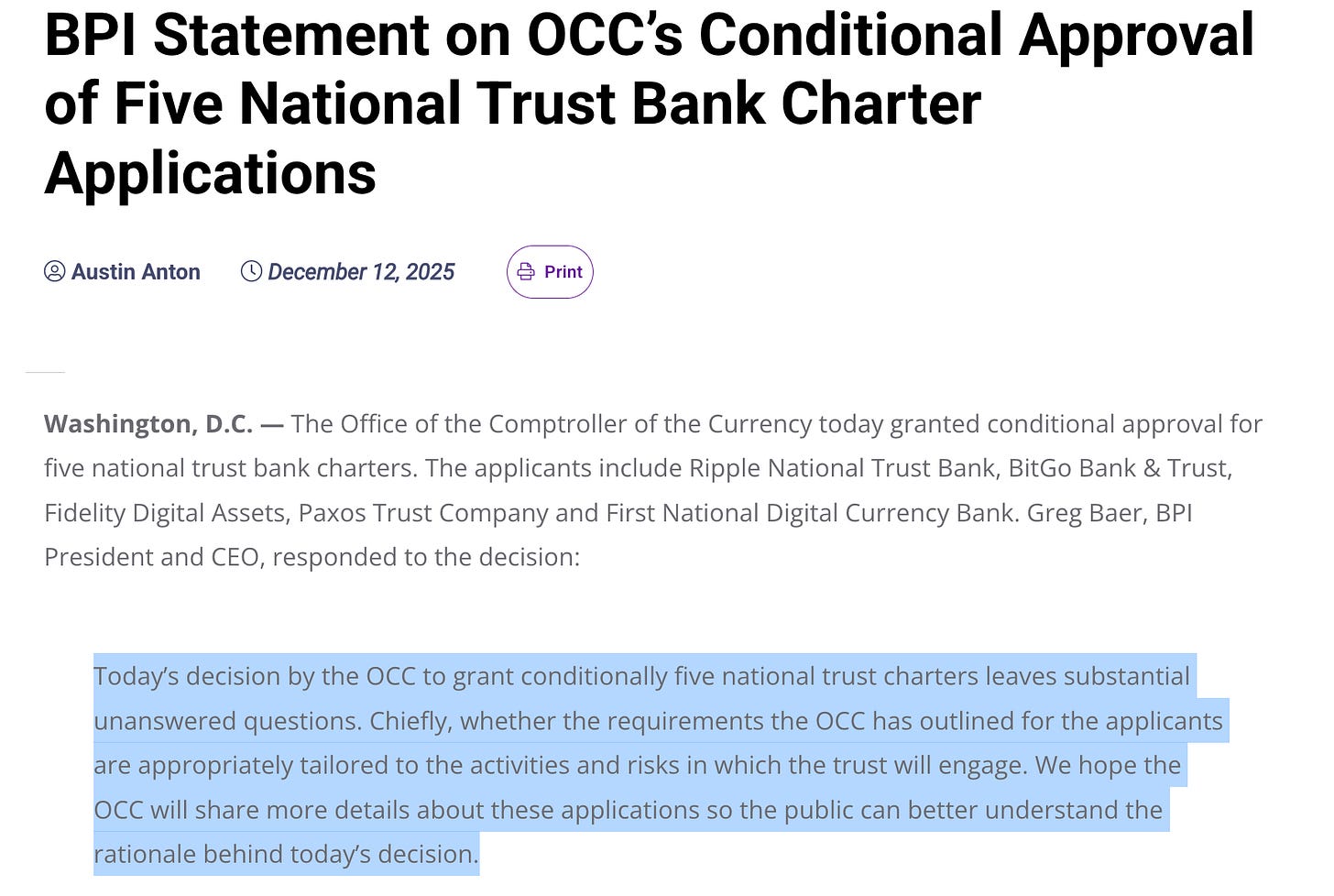
Getting a Fed master account is an even steeper uphill battle. Only a handful of non-tradition banks possess a master account. Kraken in March 2026 became the first ever crypto native company to receive a limited purpose “skinny” master account from the Kansas City Fed


The Fed has made it abundantly clear, most recently in Custodia Bank’s case, that they have unreviewable discretion to deny Fed master account even if you’re a legally charter-eligible bank.
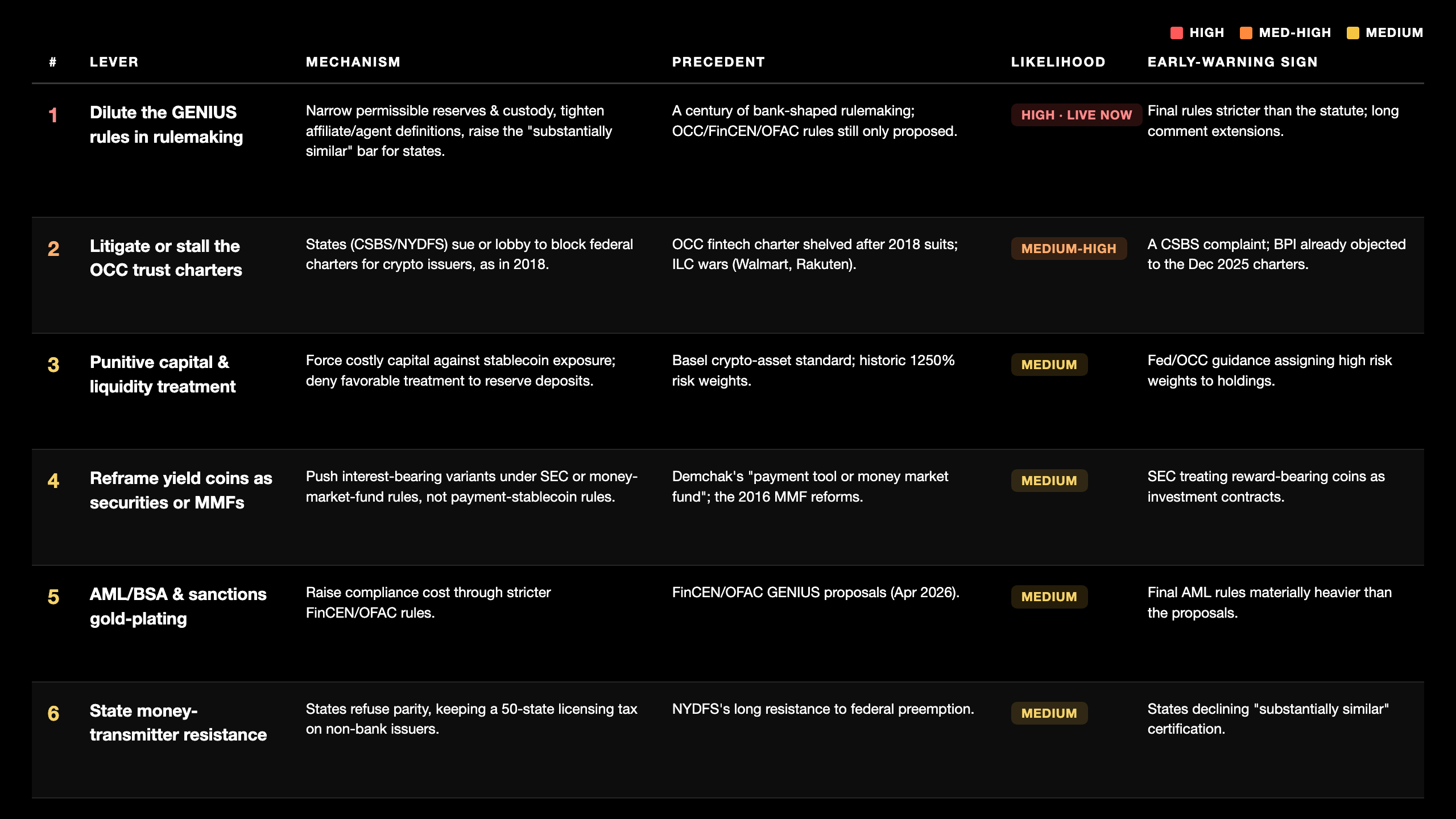
These are just a couple of roadblocks. Here’s a list of what else the stablecoin industry should expect over the next few months:
Stage #4: Co-opt and Build In-House
While Stage 3 is still in full force, proactive banks have started laying the groundwork for Stage 4, which is co-option.
When a competitor threatens to capture the customers, banks pool into a jointly owned network to create a utility they control together.
They have done it a few times:
Credit cards. When Bank of America launched BankAmericard, the predecessor of Visa, a rival cartel of banks banded together in 1966 to form Mastercard.
BofA in response had to create its own coalition with out-of-state banks. BankAmericard was later licensed into a bank-owned cooperative. They have used this tactic successfully against their own as well as against external rivals.PayPal. In the early 2000s PayPal posed a real threat to bank deposits with their high yield MMF accounts that customers could directly use for online shopping. The banks countered the threat by using their regulatory instruments to bar PayPal from receiving direct deposits and forced it to rely on banks.
But that wasn’t enough as by 2006, PayPal was handling nearly $40B in annual ecom volume. It threatened the banks to be relegated to being mere pipelines under PayPal’s banner. Eventually in 2011, a consortium of the big banks created ClearXchange which later became Zelle.
A network owned by seven banks that came pre-installed inside hundreds of banking apps. Zelle crossed $1 trillion in volume in 2024, more than double Venmo, PayPal’s subsidiary, despite launching years later. Settlement remained bank-to-bank cutting off the outsiders.
Now watch the same thing happening with stablecoins:
JPMorgan issued JPMD, a tokenized deposit, on Kinexys.
Citigroup’s Jane Fraser: “We are looking at the issuance of a Citi stablecoin. This is a good opportunity for us.”
Bank of America’s Brian Moynihan said the bank would move the moment the rules allowed.
Société Générale launched a dollar stablecoin live on Ethereum and Solana, with BNY Mellon as reserve custodian.
Deutsche Bank, through the AllUnity venture, is issuing a euro stablecoin.
Ten European banks, BNP Paribas, ING, and UniCredit among them, formed a consortium called Qivalis to issue one of their own, explicitly to counter dollar-stablecoin dominance.
US Bancorp, the fifth-largest US bank, is testing issuance on Stellar, and called the ability to freeze the coins “appealing.”
JPMorgan, Bank of America, Citi, and Wells Fargo plan to launch a tokenized deposit network, operated by The Clearing House. Their stated purpose is to keep funds inside the banking system.
The banks have made this move time and again, it’s only expected that they’d do it again.
Stage #5: Absorb the Survivors
From here, the playbook shifts to predictions, as we haven’t yet reached Stage 5. While speculative, these forecasts are grounded in recurring precedents. Our motivation at Anvesan is simply to follow this playbook to its logical conclusion.
Banks will now decide which survivors to acquire and who to starve out. Very few will remain independently competitive.
The rule for survival is simple: you survive if you hold something the bank must buy i.e. a charter, a custody moat, a regulated rail, etc.
If you compete head-on for the deposit, the banks will ensure that you can’t enter the regulated perimeter, or access rails controlled by banks. You’ll eventually be compelled to sell for pennies.
Banks have a history of buying distressed assets at a great margin:
JPMorgan took Bear Stearns at $2 a share in March 2008, raised to $10, backed by a roughly $29 billion Fed facility.
Bank of America took Countrywide in January 2008, then Merrill Lynch, about $50 billion, the weekend Lehman failed.
JPMorgan took Washington Mutual in September 2008, the largest bank failure in American history, $307 billion in assets, for $1.9 billion.
Wells Fargo took Wachovia for $15.1 billion in October 2008, outbidding Citigroup’s government-assisted offer.
And in 2023 it happened again: JPMorgan took First Republic, booking an immediate $2.6 billion post-tax gain.
Early movers are already making strategic plays, like Stripe going after Bridge/Privy; the Mastercard/BVNK deal, etc. But the big banks are yet to make their moves.
The most likely first round buys will be infra pure plays. The likes of Rain, Conduit, Fireblocks, etc are perfect entrees for the banks.
Then the kill list, anything that threatens the bank’s business model:
Yield Bearing Stablecoin <>Ethena’s USDe. It pays yield through a wrapper token, cannot meet GENIUS, is already barred from the European Union, and briefly broke to $0.97 in October 2025. The only way for it to survive is offshore as a DeFi instrument, without any access to the regulated rail.
Non-compliant issuer<>Tether’s USDT. Walled out of the United States, surviving offshore while a compliant version, USAT, runs through a chartered bank. Not nearly as threatening.
Non-compliant structure<> DAI. Decentralized by design, it cannot meet GENIUS requirements, and need to stay in the DeFi niche.
Rented Rails <> Weak-licensed consumer apps. Most of the popular neobanks suffer from this. They are quite thin on rail/license/charter ownership. When the rail owners raise the price, they will either be bought out cheaply or get regulated out of existence.
Stage #6: The Endgame.
Every disruption only makes the biggest banks bigger.
The evidence is the whole history of bank crises:
A Forbes study in 2014 showed 5 big banks controlled 44.4% of all US banking wealth ($6.8T out of $15.3T). They benefitted from a crisis of their own making.
After 2023, deposits fled the regional banks to the too-big-to-fail tier, and JPMorgan absorbed the largest failure since Washington Mutual.
Across the whole era, the number of US banks fell from roughly 14,000 in the mid-1980s to about 4,500 today. Two-thirds of America’s independent banks got swallowed by the big banks at the top.
Stablecoins pose the same threat as all the previous disruptions. They compete for non-interest-bearing deposits, the cheapest money a bank holds. Because regional and community lenders rely most heavily on these deposits, they face the capital flight first.
The giants are insulated from this threat. Every stablecoin dollar parked in t-bills at a US bank pulls foreign deposits back into the system. The system the giants already dominate.
The banks do not need to kill stablecoins. They want to be the one to issue it, custody it, and clear it. The likely outcome is stablecoins thriving, while the deposits concentrate further toward the giants while the few fintechs that survive depend on banks for the most part.
The Positives
Although big banks make formidable enemies, it’s not all doom and gloom for stablecoin companies. While the threats are real and approaching fast, a few things are different this time around.
Unlike the historical choke points faced by money market funds or PayPal, traditional banks cannot simply clone stablecoins or lock them out of clearing networks. Anyone with access to a public or bespoke blockchain possesses the independent ability to conduct stablecoin operations.
On top of that the banks and regulators have a rare conflict of interest regarding stablecoins.
The U.S. Treasury relies on stablecoins as structural buyers of debt. Stablecoin issuers currently hold $155B+ in shortdated tbills, ranking them alongside the top 20 sovereign holders of US debt.
This baseline demand has emerged as a serendipitous buffer against growing global de-dollarization trends.
Today, stablecoins act as a vital geopolitical tool that subsidises U.S. fiscal deficits while structurally enforcing digital dollarization across the internet.
Furthermore, the current agencies overseeing stablecoin regulation are the most crypto-receptive in history, actively pushing through positive regulation like the GENIUS and the CLARITY acts.
All remnants of hostility from the previous administration’s agencies that facilitated Operation Chokepoint 2.0 are gone. The regulatory landscape is ideal for rapid growth.
BUT, this does not lessen the obstacles for fintech companies. While stablecoins control the payment infrastructure, legacy institutions still have unilateral control over legal charters, regulatory orchestration, and geographic on/off-ramps.
How a stablecoin company actually wins, following in PayPal and Stripe’s footsteps, by owning the charter, the customer, and competing where the bank cannot follow, is the subject of Part 2 of this article.
Follow @anvesanorg to stay updated.
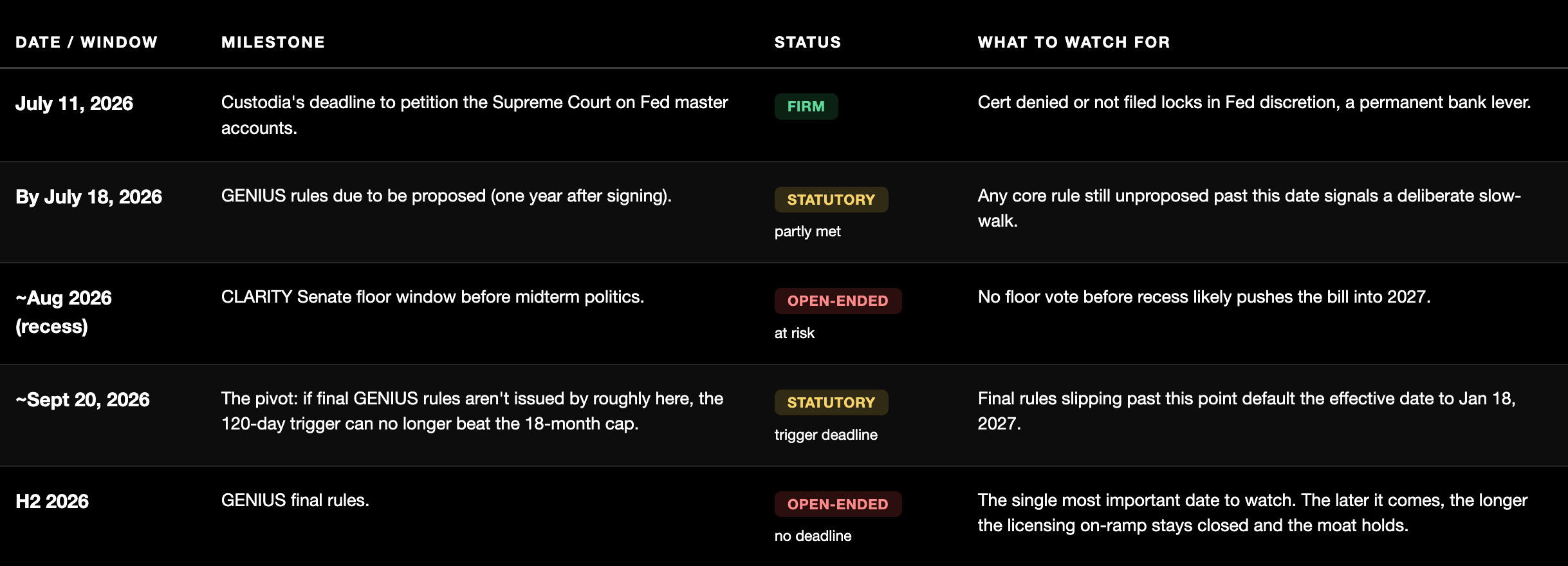
Dates to monitor
The following schedule outlines the critical hearings, petitions, and deadlines shaping stablecoin regulatory clarity. Any irregular delays, postponements, or cancellations will serve as an immediate signal that banking lobbies and captured regulatory bodies are executing the playbook. Monitoring these dates closely.
Anvesan is an independent stablecoin think tank: technical, regulatory, and policy. The content of the article is not financial advice.