

The golden rule of building a worthwhile retail interface is to reduce friction in the UX.
Whatever the current default consumer behavior is, simplify it or enrich it without adding extra steps.
Stablecoin cards pass this test with flying colors. The checkout flow remains the same as an ordinary card. And you can pay in dollars/crypto anywhere on the planet without being charged extortionate fees.
Whatever changes mechanistically take place behind the scenes.
The opportunity to silently embed stablecoins inside every card is worth multiple trillions of dollars. And the competition in the space is gearing up.
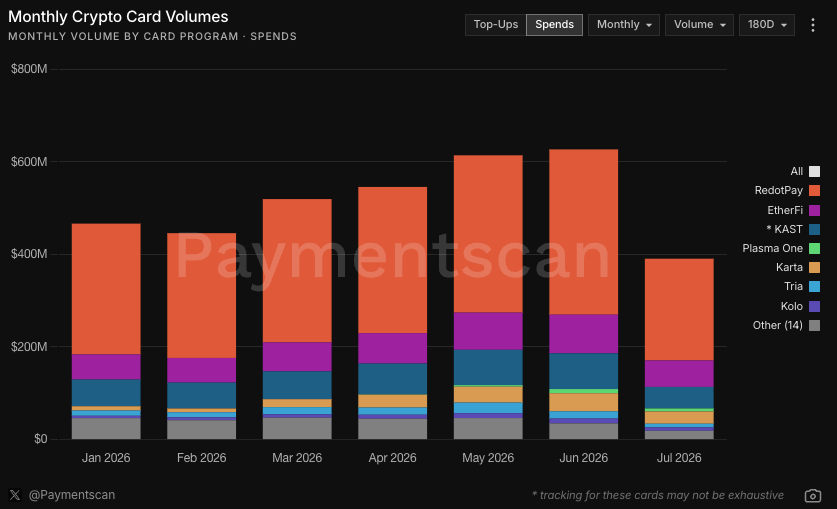
Card-linked stablecoin spending hit $4.5 billion in 2025, up 673% from the previous year. This year it’s already crossed $3.5B+ to date according to data from Paymentscan, with total card funding sitting above $5B.

Visa supports 130+ stablecoin-linked card programs across 50+ countries, and its stablecoin settlement pilot reached a $7 billion annualized run-rate in April, up 50% in a quarter, across nine blockchains.
The point of this essay is to paint a picture of how stablecoin cards work behind the scenes, what the stack looks like, and who’s taking advantage of this opportunity.
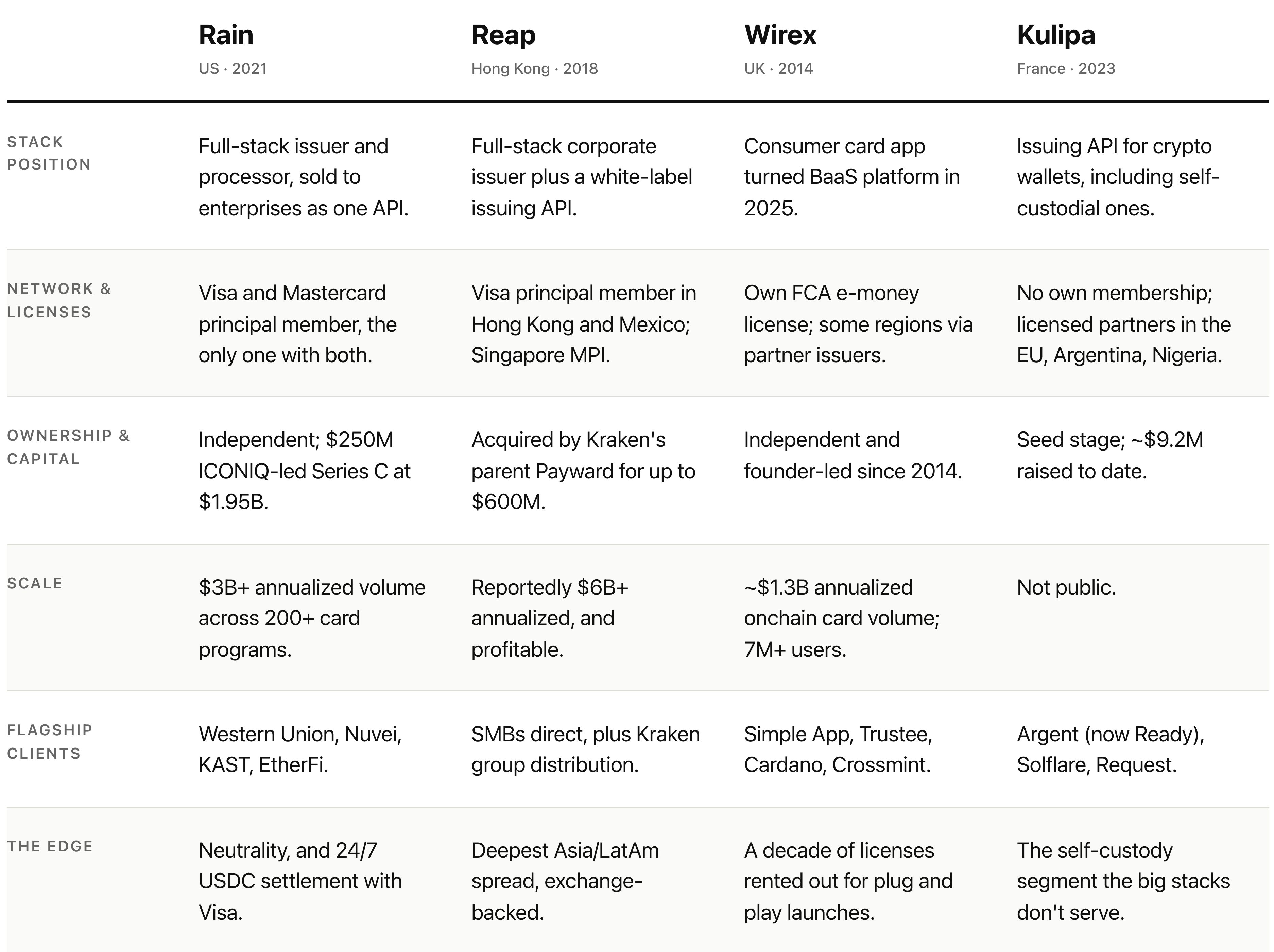
We’ll be looking at four companies in particular: Rain, Reap, Wirex, and Kulipa. None of them is a 1:1 competitor, they are all approaching the goal of dominating the payments stack from slightly different angles.
Rain is by far the biggest, worth $1.95 billion. Reap got acquired by Kraken for up to $600 million. Wirex pivoted from a decade-old consumer brand to a BaaS model. And Kulipa is a seed-stage bet, carving out a segment in this hypercompetitive space.
Business Model Breakdown: Rain, Reap, Wirex, Kulipa
To see where these four compete, you need the stack in your head.
I was planning to create a stack chart, but then I found this one from Artemis. They knocked it out of the park, so I decided to just use this.
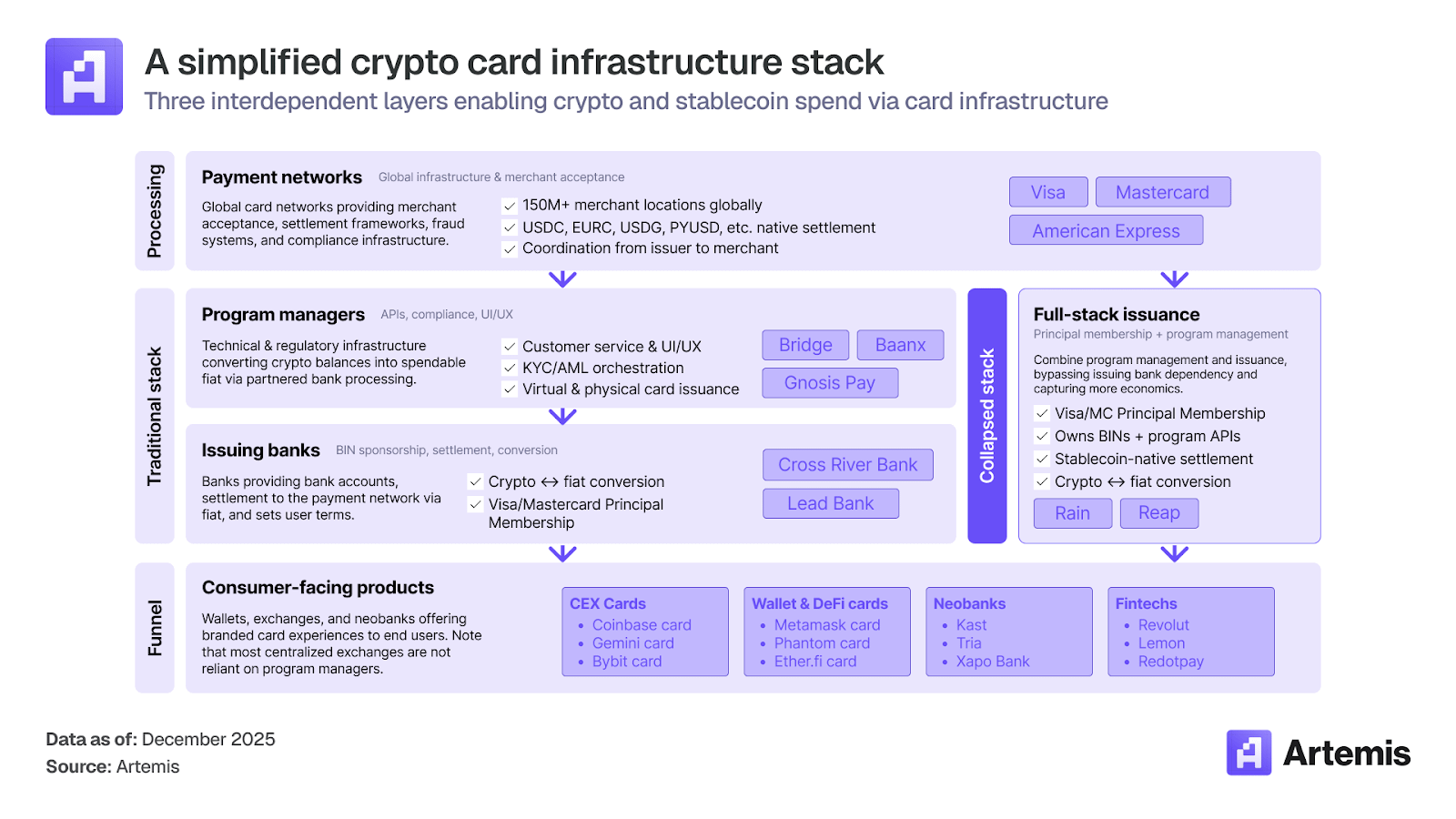
As you can see, a card program has four layers: the network (Visa, Mastercard), the principal member who holds the BIN and settles directly with the network, the program manager who runs compliance, KYC, and the ledger, and the brand whose name is on the card.
Every fintech card you have ever used runs on this stack.
The most powerful entity in here is the card network. Visa and Mastercard have built a network completely ingrained in the modern financial architecture. 90%+ of all card transactions on earth get settled through either of these two giants (Visa/Mastercard’s market share is roughly 70/30, ex-China). Meaning they own the highways and they decide the toll for each transaction to pass.
But the card networks don’t touch the money flowing through the plumbing directly. They sell Principal Memberships to financial entities, a bank in the US, a licensed financial entity elsewhere, which actually operate the flow and interface with the card brands.
Think of a feudal hierarchy: Visa is the monarch that shares its resources with local lords to run the system effectively. The Principal Member is the most powerful landlord (equivalent to a Duke in our analogy), the Program Manager is a rung below that, and so it goes. Each layer collects rent (interchange fee) from the lower rung and sends it upward.
Rain
Rain, in our example, merges the principal member and the program manager together and collects a higher percentage of the fee.
Starting in 2021, Rain’s focus was issuing credit cards to DAOs, groups that held millions in stablecoins and could not get a bank account.
Rain’s had to figure out the tools it needed from first principles: onchain settlement, its own smart contracts, compliance program, and eventually its own network memberships.
Charles Yoo-Naut, Rain’s Co-founder, describes the stack as “you have your bank partner, you have your program manager, you might have a reseller, and then you actually have an app. We’ve merged those hops. There’s no reseller, there’s no program manager, there’s no bank, it’s just Rain”.
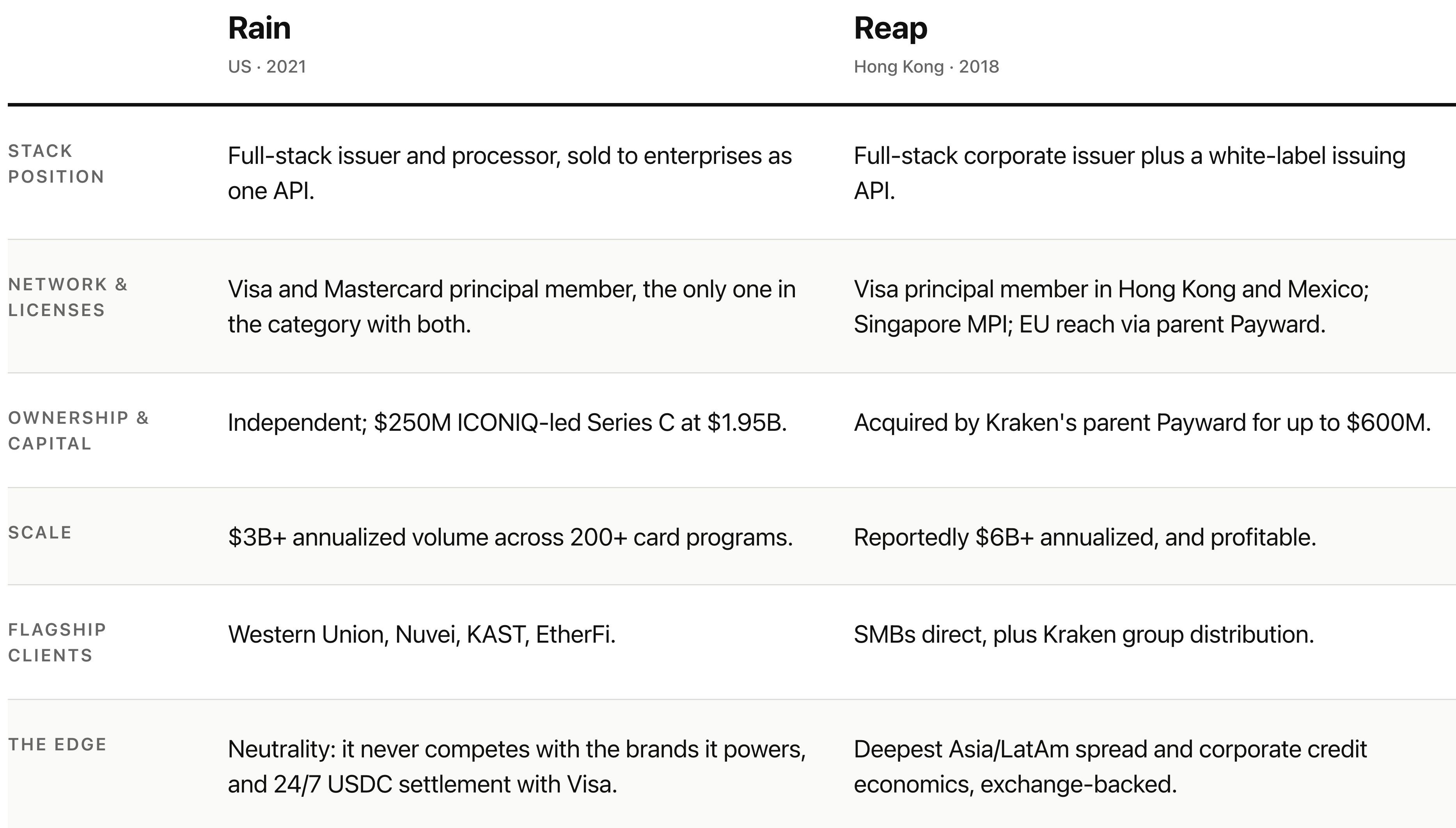
Rain became a Visa principal member in March 2025, a status historically reserved for banks. It has since added Mastercard principal membership as well. Today, Rain powers 200+ card programs, including Western Union, Nuvei, KAST, and EtherFi, runs $3 billion-plus in annualized volume after growing 38x in a year, and brings in around $100M in revenue. In January, ICONIQ led a $250 million Series C at $1.95 billion, a 17x markup in ten months.
Reap
Reap is the other prominent name in this stack. They approached the same business model with a twist. They chose Hong Kong as their base of operations instead of New York, got their Visa principal membership in Hong Kong and Mexico, and are focused on developing a full stack product instead of just the infra as Rain.
Earlier this year, Daren Guo shared their numbers on Peter Renton’s podcast: north of $6 billion a year in volume, revenue up 8x in ten months, profitable for more than a year, 250 people across 28 countries.
Where Reap is similar to Rain: As a Visa PM, it settles directly with Visa, in Hong Kong and Mexico. Reap rents its platform and licenses it out to card issuers in regions they operate in, acts as a program manager, and collects a percentage of the fees.
Where Reap differs from Rain: Reap offers a stablecoin-collateralized USD credit card to SMBs, putting them directly in touch with the end users, a layer Rain deliberately doesn’t operate in.
The collateralized credit card model is interesting: a company gives Reap $100 in stablecoins, receives a $100 secured credit line, and Reap works with issuers and market makers to settle Visa in fiat behind the scenes.
It holds Visa principal memberships in Hong Kong and Mexico, and a fresh MPI license in Singapore, and it powers neobanks in Africa and Brazil. On July 1, Kraken’s parent, Payward, completed its acquisition of Reap for up to $600 million. I wrote about it in March when the acquisition was announced.
Wirex
Wirex is a reflection of how the stablecoin card market has changed in the last 10 years. Wirex is the oldest company here, a 2014-vintage consumer crypto card app with 7 million users and $20 billion in lifetime transactions.
It holds its own FCA e-money license (the third crypto company ever to get one), though parts of its card issuance run through partner issuers by region. In 2025, Wirex made a strategic pivot to collect rent instead of scavenging for fees with other neobanks in an increasingly competitive landscape.
So Wirex packaged a decade of licenses, processing, and card operations into a BaaS platform. Also, it settles directly with Visa onchain and is the only company in this list that settles in both USDC and EURC. As per their company materials, they onboarded 300+ enterprise clients and reached a $ 1 billion annualized run-rate faster than any competitor’s record, plus a stablecoin Push-to-Card product on Visa Direct that can pay out to 3 billion cards in 200+ countries.
Important to mention, Wirex is still active in the consumer space. They recently launched Wirex One, a yield-paying consumer app. It’s similar to Reap, where the service provider is competing directly with its tenants. It’ll be interesting to see if the winning play is to go neutral or own the stack with a consumer product.
Kulipa
The infra stack of stablecoin issuance is a place for players with means. Acquiring licenses, onboarding major enterprise clients, operating in multiple jurisdictions — it ain’t cheap.
That’s where Kulipa is different. Kulipa entered the market with $9.2 million in total fundraising. For reference, Rain has raised $332 million to date, and Reap was acquired for $600 million.
Kulipa, founded in Paris in 2023 by Axel Cateland (ex-Mastercard), issues white-label cards for crypto wallets, with a specialty the bigger players generally avoid: self-custodial wallets, where there is no deposit-taking relationship or any KYC requirements (on the wallet side).
Axel’s pitch is total absorption of the problem: “We offer the full solution…We come with the licenses. We come with the tech”.
Its first flagship client was Argent, now Ready, whose metal card spends USDC straight from the wallet while the merchant receives euros, completely oblivious of the underlying flow. Kulipa has regulated issuing coverage via partners in the EU, in Argentina accessing LatAm, and in Nigeria.
From my perspective, the play is to target clients that are small for the incumbents’ taste. A low-maintenance plug-and-play compliance layer is perfect for early-stage neobanks.
Where these 4 compete: Rain and Reap occupy the same layer, principal membership, and program management. The Kraken acquisition now makes Reap exchange-owned, while Rain remains firmly neutral. Wirex and Kulipa sell launch speed to smaller fintechs in slightly different ways. Wirex leverages its decade-old industry contacts and insider knowledge to play the board, whereas Kulipa is positioning itself as a compliant low-lift stack with self-custodial features.
There is one challenger in this category that I want to mention, although public information is scarce, so I can’t go in depth. Bridge (owned by Stripe) partnered with Visa to issue stablecoin-linked cards through a single API last year. They have since launched across several LatAm countries with the express goal of expanding to 100+ countries by the end of this year. Given Stripe’s giant merchant network, it can indeed build a formidable competitor to eat this stack. I’ll be watching how this develops.
Why the Exponential Value Accrues at the License Tier
Let’s follow a $100 spend on a stablecoin card.
The holder spends $100. The merchant receives roughly $97.50. Visa takes its network cut, and the bulk of that ~$2.50 of interchange flows back to the issuer, Rain, which shares a negotiated slice with the brand.
Rain also charges SaaS fees in three tiers plus usage fees per KYC, per card, per transaction. The category norm across the industry is an interchange of 1 to 2%, plus FX spread, reserve yield, and cardholder fees.
That’s how much power the upper layers of the stack wield. The Principal decides the revenue split with the brand with what’s left after Visa’s cut. The card brand can only negotiate up to a certain point based on volume and region.
Every consumer stablecoin card you have seen advertised, with its cashback and metal body, is a tenant. The four companies in this essay are the landlords. The landlords get a cut of every swipe of every tenant.
KAST raised at a $600 million valuation as one of the hottest consumer brands in the category. They expect revenue to reach $100M in 2026. Rain, its landlord, is worth ~$2B at the same revenue range. Because Rain’s moat is much more defensible.
The second, less discussed economic engine is collateral. A traditional issuer has to park roughly four days of spending as collateral with the network, because Visa authorizes transactions 24/7 but they can only settle during banking hours.
Rain tokenizes the receivables and settles Visa in USDC 24/7/365. Meaning Rain can settle directly over a weekend where legacy institutions would have to put up 2-3 days’ worth of collateral to run the same volume. It frees up a significant amount of dead capital they can deploy elsewhere.
The third engine is the primary moat: accumulated regulatory suffering. Rain co-founders describe the strategy as: “If something is hard to do and you do the hard thing first, it’s very difficult to undo it or have somebody else do it... if we can just chew this glass and get through this, that’s part of our moat”. Comparing it to the AI era, software is becoming cheap, so the hard parts that remain, licenses, network memberships, compliance programs, are the moat.
Rain took two years of its four-year life to get Visa principal membership, navigating the behemoth that is Visa with no guidebook.
Reap assembled principal memberships and licenses across Hong Kong, Mexico, and Singapore over seven years. This is why the market pays infrastructure multiples for these companies while consumer brands, however fast they grow, get consumer multiples. The license tier is the most defensible, so the license tier is where the exponential value accrues.
Winner Profile
It’s still very early to predict who the winner will be or how many of them. But examining the four models, it gives you a clear idea of what you need to win in this category.
Multi-region principal memberships. A traditional issuer needs a new bank partner for every new jurisdiction, while Rain can settle globally with one integration. Reap can make the same argument across Hong Kong, Mexico, and Singapore.
Stablecoin-native settlement. The 4-day-to-1-day collateral advantage will crush any issuer still settling on legacy rails following banking hours. This freed up capital will allow them to make much more compelling offers to clients.
Neutrality. Rain serves 200+ brands that compete with each other, and can do so only because it doesn’t compete with its clients. This is the classic infrastructure position, and it is now Rain’s strongest differentiator against Reap. Post-acquisition, Reap is controlled by an exchange that has consumer ambitions of its own. Wirex looks like it’s walking the same road. They have some work to do to convince existing clients why they should buy from their competitors.
Who wins the biggest? Visa carries over 90% of onchain card volume. The vast majority of these companies depend on Visa’s onchain settlement pilot. The narrative has completely flipped from stablecoins replacing card networks to stablecoins turbocharging them for another century.
70% of all cards in the world have a Visa logo on them. Stablecoins enable those cards to have direct access to dollars anywhere on the planet. Dee Hock himself couldn’t have imagined an opportunity like this as it stands today.
What I Think of the Future
Standard Chartered projects stablecoin supply at $2 trillion by 2028, from roughly $310 billion today. Card-linked spend is compounding at 673% on a $4.5 billion base. But the actual numbers are a rounding error compared to the opportunity. Based on Paymentscan data, total stablecoin card spending in the last 12 months crossed $6B. At the category’s 1 to 2% interchange norm, that creates a revenue pool of a hundred million dollars or so a year for the whole stack.
10x spend volume will bring us to a billion-dollar revenue pool. Even then, it’ll be under 1% of global card volume. The opportunity here is massive, and we are at the proof-of-concept stage.
Demand is not the constraint. Visa can swap its entire legacy rail architecture with stablecoin rails, and the end users won’t notice a thing. The biggest constraint will be regulation and licensing. Licensed capacity takes years to build and maintain with heavy oversight. And the business is too lucrative for the incumbents to go down without a fight.
Another risk, which not enough people are discussing, is the emerging-market regulators. The same countries where these cards have the highest demand. If a consumer has direct access to USD through stablecoins, it threatens the very fabric of financial control in a sovereign nation.
On top of that, if they don’t need to convert it into the local currency to spend it, it depletes the local USD reserve, another blow that most BRICS or ASEAN countries won’t take lightly.
In all financial disruptions, the regulator is a bigger obstacle than the competitor. The fight will be slow, and the winners will be well-capitalized, politically influential entities.