

Anyone who knows anything about stablecoins knows it’s better than banks.
After all, banks run on an age old system called correspondent banking, where to send money from one bank to another, it has to go via five other banks. Because not all banks have direct communication with each other.

This process sometimes can take days, especially if it’s around a holiday. The average number of days in a year when banks don’t work is 117. Out of 365 days.
That’s 30% of the year.
And on those days when banks do work, they only work for 8 hours. Another 16 hours per day wasted.
Archaic. Bleh!
Stablecoins work 24/7/365. You can settle a stablecoin transaction instantly across the world without ever needing an intermediary.
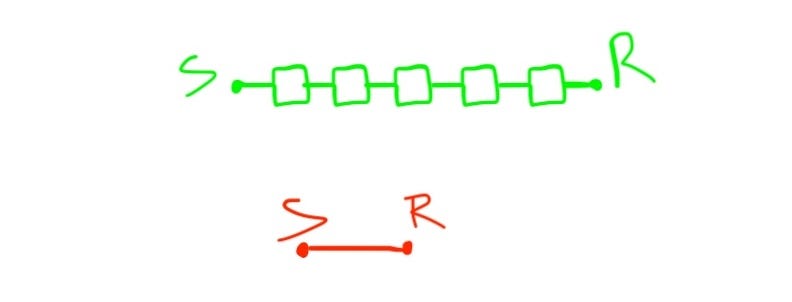
You can see it in this visual. It’s that simple.
So stablecoins have won the game. That’s it!
That’s it, right?

Actually this is what the transaction looks like in the real world.
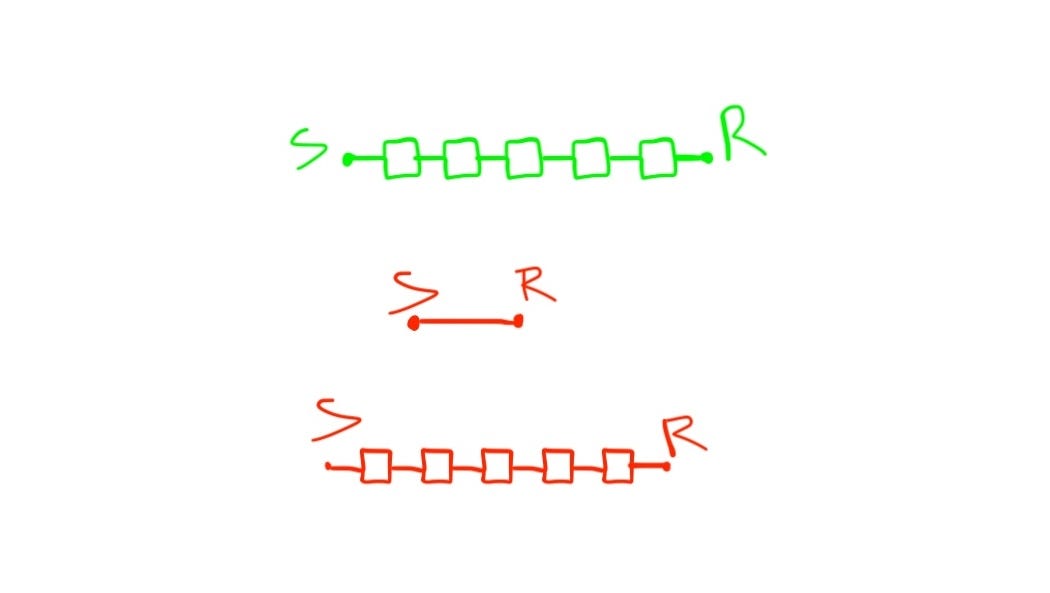
A stablecoin transaction going in and out of fiat rails looks practically indistinguishable from a generic fiat transfer. Both in the number of hops and fees.
The transaction requires an orchestrator who coordinates with onramps to convert fiat into stablecoins, FX entities to convert the stablecoin into the local currency, and local licensed fiat entities to deliver the last mile.
And just like the banking system, every entity takes a cut of the transaction.
Why is that?
Why do stablecoins, despite having solved the problem using blockchain, still suffer from the same burdens as fiat?
I dug through my notes and spoke to some people to answer this question.
Why are stablecoins “slow and expensive”?
I have been thinking about writing a orchestration piece for a long time. How it’s going to melt the boundaries between fiat and stablecoin and become one money.
What I didn’t realize was the complexity of cross border stablecoin payments isn’t technological. You could have the best possible technical solution to the speed problem (aka blockchain) and still be no better off than an MTO on legacy rails.
Before I explain, here’s what the BIS Annual Economic Report 2026 says about stablecoin cross border payments:
It is often claimed that cross-border remittances are an area where stablecoins are attractive. In practice, the costs of on-ramps and off-ramps to stablecoins mean that the total, or all-in, cost of a cross-border stablecoin transaction may be as high or higher than a bank transfer.
The claim is based on a study conducted earlier this year at the Harvard Business School.
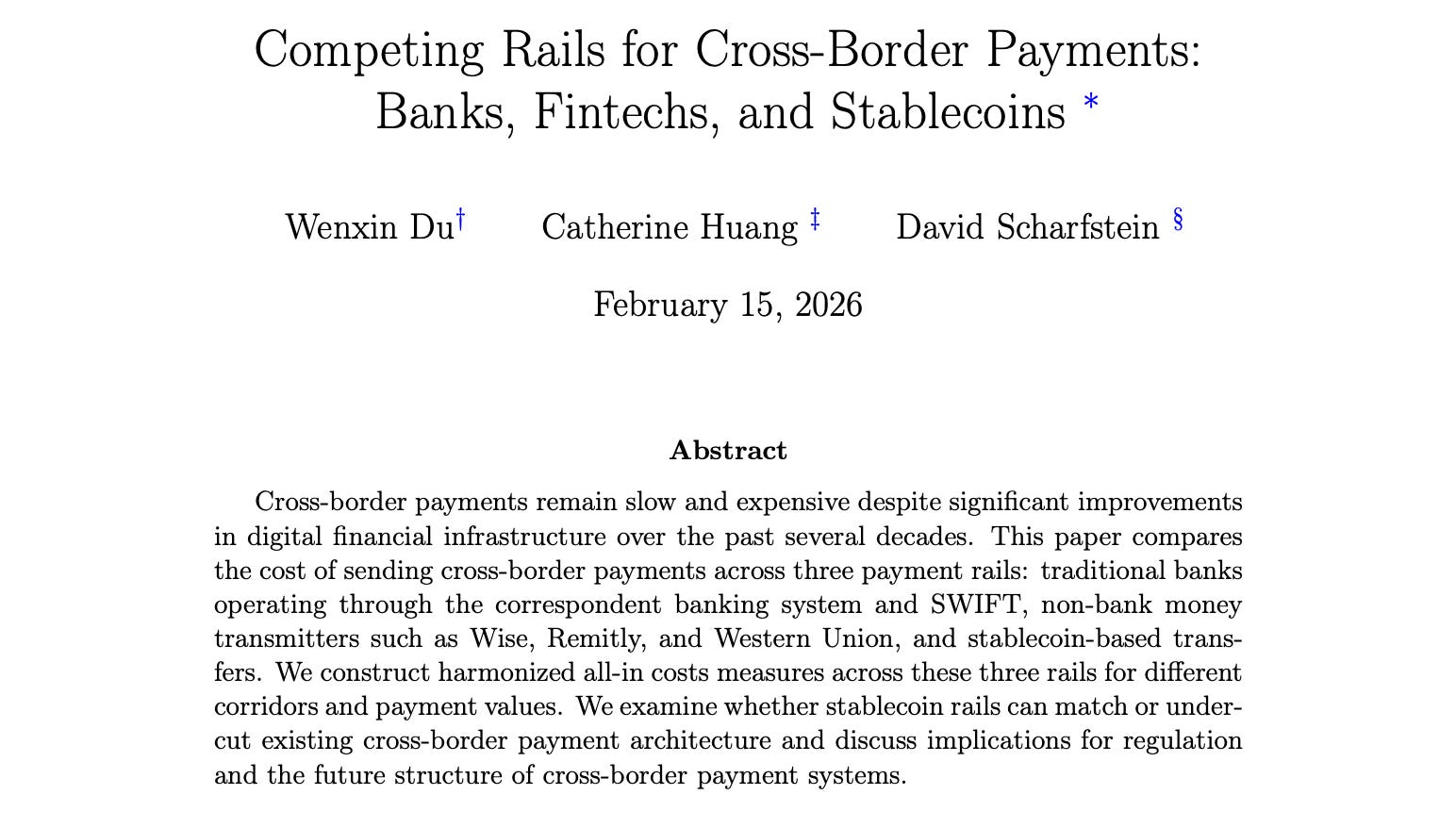
The Harvard team compared one payment going through three different rails: banks on SWIFT, fintech MTOs, and the stablecoin sandwich.
The findings, roughly:
Banks charge 200 to 400 bps of FX markup (300 bps median) on retail international transactions. Even on the most liquid currency pairs, that’s the markup. (Excluding Wire fees)
90% of SWIFT-based transactions arrive in the destination bank within 1 hour. But it can take several hours to become available to the receiver.
The spread on the wholesale FX market on those same currency pairs is 6 to 9 bps.
The fintech companies charge anywhere from 40 to 400 bps all in, depending on the corridor and transaction size. And they got there without a blockchain: prefunded local accounts, internal netting, and other assorted neat accounting tricks.
In most cases, Fintech MTOs take minutes to a few hours to arrive at destination.
So the benchmark is right there in front of us. Stablecoins need to be faster and cheaper than the above examples.
The Harvard study tested primarily CEX → CEX transactions. Person A adds $100 USD on Coinbase, converts it into USDC, sends it to Person B on Kraken in Europe, who then off-ramps it to their bank account in euros.
Kraken charges a flat 1 percent trading fee if you do under $10,000 a month, plus a fixed euro withdrawal fee.
The total transaction cost ends up being around 2.20%.
It’s basically a median performance, against banks and legacy fintechs. Certainly nothing mindblowing.
So I ask myself why?
There are two answers to this question.
First, the Harvard study draws an incomplete picture of the stablecoin payments landscape. CEXs are possibly the worst venue to track cross-border transaction efficiency. Those platforms are designed for trading, not transacting. (But I’ll acknowledge that data is sparse on other venues, something I myself faced during this research)
Also, their dataset is extremely thin across platforms. The team only reported transaction details they manually performed. It didn’t come from a sourced list of thousands of verified transactions over a predetermined timeline.
I wouldn’t hang up my gloves because of this study.
However, however...
The study is right that there exists a stablecoin sandwich: a long chain of intermediaries through whom zigzaggingly travels the transaction.
Here is a visual from Conduit explaining the EUR to USD payment flow through Tempo.
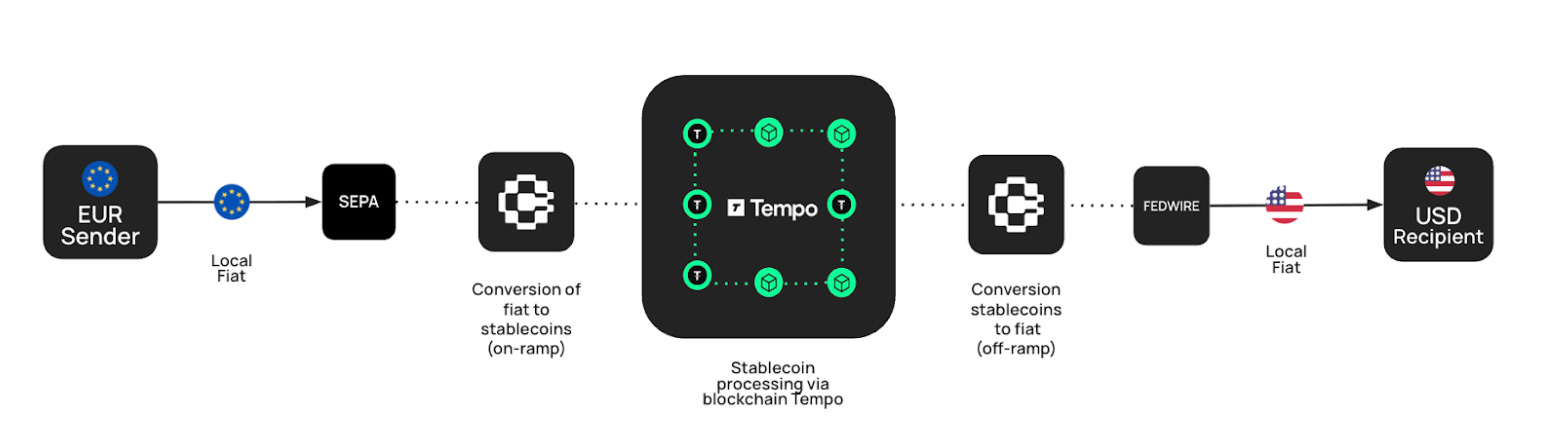
But this is very much a case where you need to blame the game, not the player.
To test the efficacy of the stablecoin rail, I wanted to perform my own research. So I chose the most liquid and competitive corridor in the world as the battleground — US-Mexico.
Baptism by Fire
For context, the US-Mexico corridor transacts $65B per year. Every major player wants a piece of this corridor, including stablecoin rails.
I pulled the World Bank data on this corridor from Q3, 2025 (the latest available).
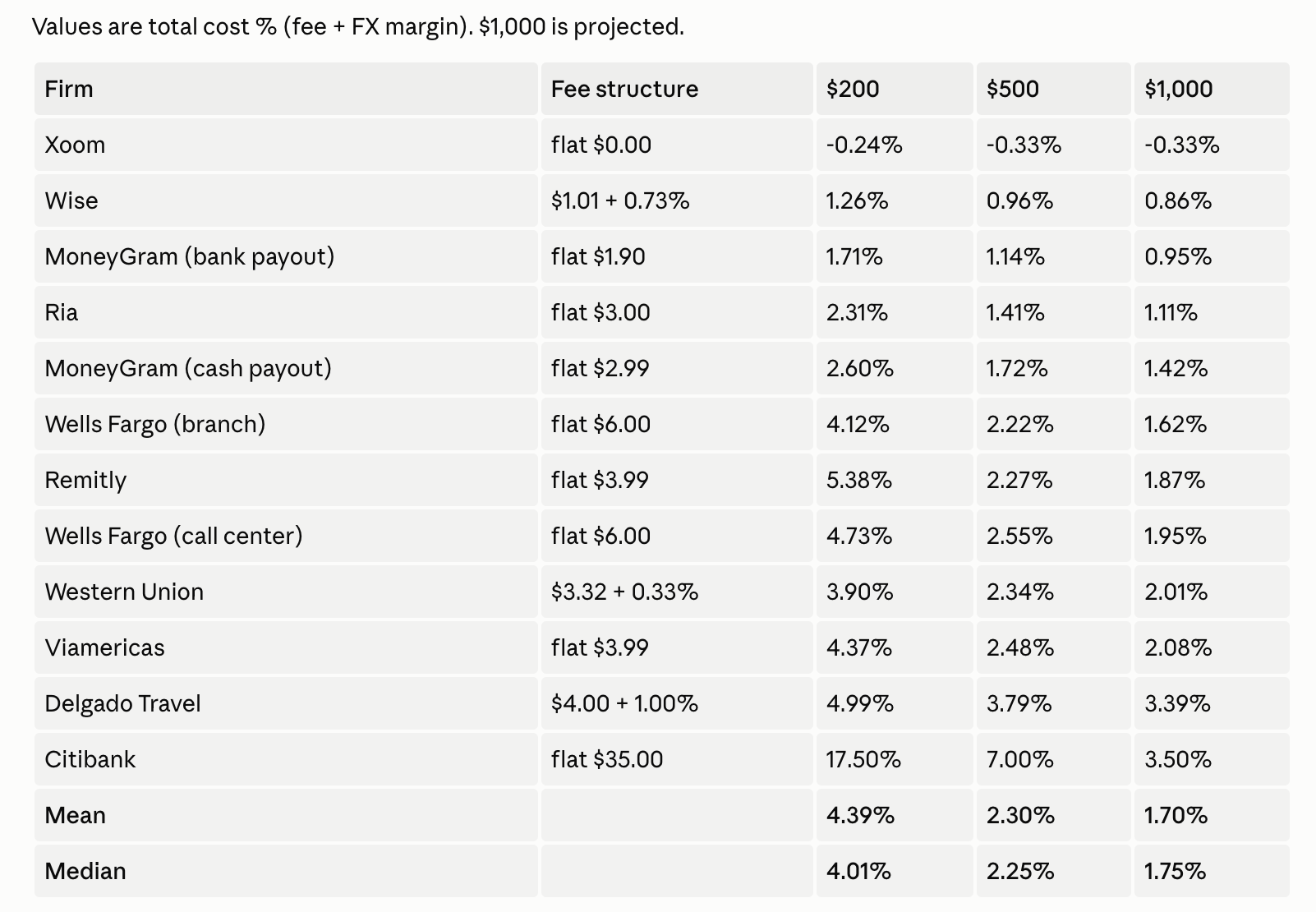
It’s a mix of banks and MTOs competing on fees on retail size transactions. The margins don’t get any thinner than this. It’s that competitive. The median transaction amount on this corridor is close to $400, putting the actual fees closer to the $500 column.
I wanted to see how a stablecoin app would stack up against these platforms. (not considering MoneyGram as a stablecoin play as that happened after this dataset was recorded)
The best example I found is Felix Pago. It’s a WhatsApp based money transmitting platform that serves the US-LatAm market.
I hit the same wall as the Harvard study as available information on Stablecoin rails is scarce and mostly self reported by orchestrators. Given their own stake in the game, I can’t take those numbers at face value, but they do serve as best case scenarios.
That being said, several sources converged on Felix Pago as the unanimous choice for this category.
Circle’s case study (July 2025) says Félix converts USD to USDC through Circle Mint. Stripe’s page says Bridge, a Stripe company, supplies the USDC and USD liquidity. And on the Mexico leg, Bitso converts the USDC to MXN. Which is then delivered through SPEI (Mexico’s real-time interbank system).
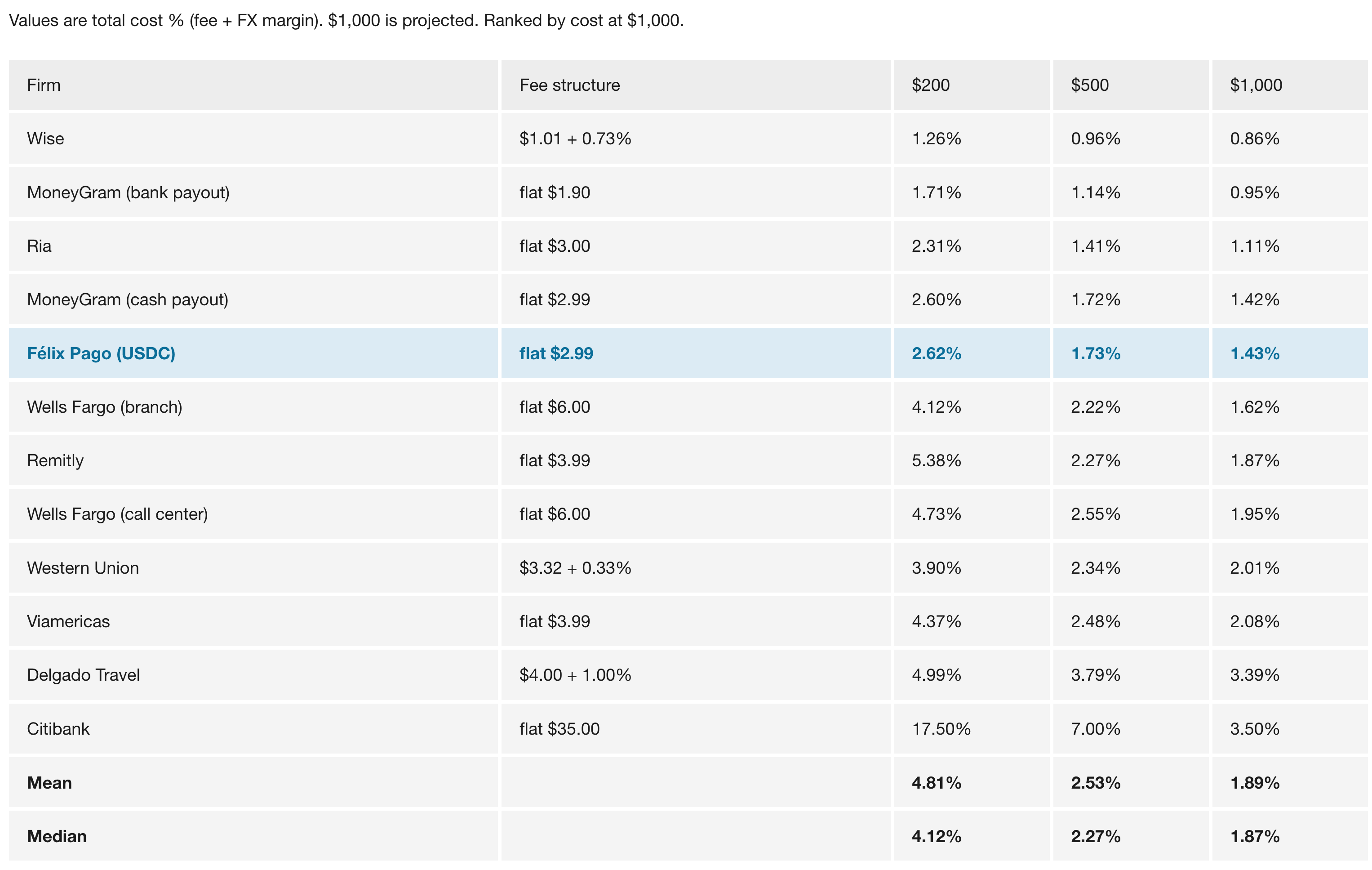
I arrived at the estimates through extrapolation and inference of publicly available data. The flat fee of $2.99 is factual.
As I said, my goal was to test the efficacy of the stablecoin rail in the most competitive corridor of the world.
As it stands, benchmarked against World Bank data and my own research, it’s in the top 5. Is it competitive? Very much. Does it blow legacy rails out of the water? Not really.
It gets beaten by the likes of Wise and MoneyGram on certain legacy rails, without a blockchain, head to head in this corridor.
I again question myself, why? If the actual transaction is completed in seconds for a negligible amount of fee, why doesn’t stablecoin win outright?
To understand the answer, we need to look under the hood of stablecoin orchestrators.
Under the Hood
Fiat and stablecoin don’t talk to each other. An orchestrator acts as an adapter between the two rails. It ‘orchestrates’ a series of financial entities to perform a multistep rail+currency conversion procedure.
I’ll try to unbundle the stack of three different orchestrators to break down what the actual flow looks like and who/what influences the fee and speed components.
Bridge
Conduit
zerohash
I didn’t speak with any official sources from these companies, the following information is based on their public documentation.
Here is the generic flow before we get into who does what differently. The flowchart tracks a $1000 payment from the US to Mexico.
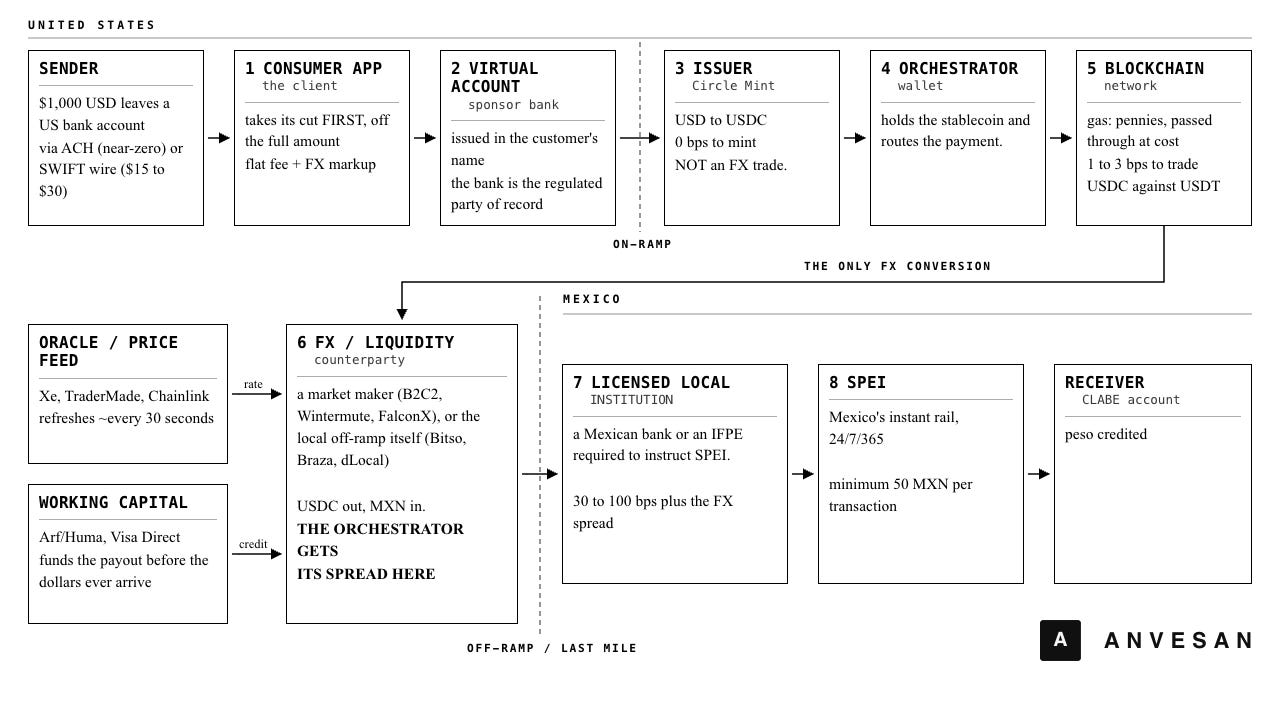
It’s about 8 hops, give or take a couple. You have two predictable fees charged by the consumer app and the orchestrator and one unpredictable FX fee based on market rate.
Bridge
Components in one US to Mexico transfer
the consumer app (Félix for example)
Bridge (the orchestrator)
Circle Mint (dollars into USDC)
a blockchain
a market data provider for the effective rate
an FX Counterparty for currency conversion
a Mexican licensed institution for last mile(SPEI access)
Fee Breakdown
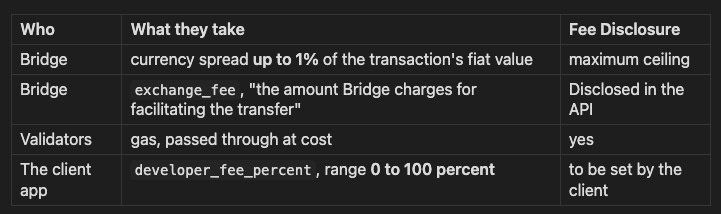
Bridge carefully positions itself to not have any currency risk on its books. It doesn’t lock in any fixed rate for a transaction over any period of time (others do). So the effective rate hinges on the FX swap rate at the time of conversion.
Stripe’s 2026 annual letter reported that Bridge’s transaction volume more than quadrupled during 2025. That implies roughly $20B annualized going into 2026.
zerohash
zerohash, while following a similar structure to Bridge, has a few key differences in its architecture.
Its own internal principal desk (zerohash liquidity services llc) acts a counterparty on some transactions. And they offer a rate lock of 5 to 30 seconds to initiate a transaction.
Fee Breakdown
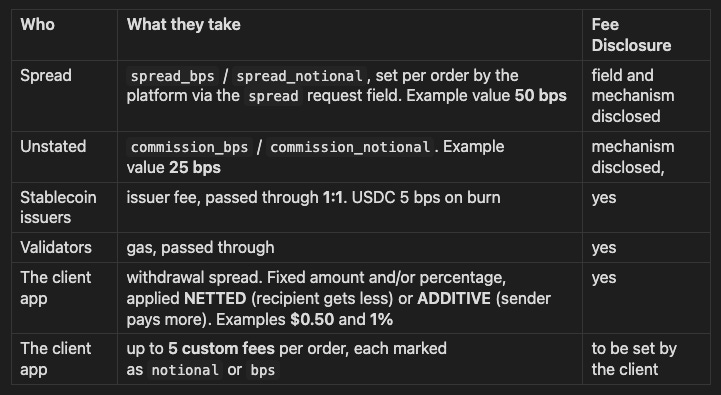
zerohash in their 2026 Stablecoin Momentum Report mentioned $65B in total settled volume across more than 7 million end customers with a 690% yoy growth in transaction volume.
Also interestingly, before Mastercard acquired BVNK for $1.8B, they offered to acquire zerohash for up to $2B, but zerohash declined. One of the clearest signs of conviction in this space, and it shows the ultimate valuation for companies like zerohash will be orders of magnitude larger.
Conduit
There aren’t a lot of disclosed partner entities in the above two examples, but with Conduit I managed to find a few.
Conduit uses Braza Group for Brazilian FX, the CPN for the Mexico corridors, Yuno for distribution, Tempo as the chain, and somewhere between 20 and 30 banks. Take these names with a grain of salt as public documentation doesn’t necessarily disclose the entire network.
Fee Breakdown
I found this formula in Conduit’s API documentation. It doesn’t go any deeper than that, but it gives us the shell.
endUserRate = referenceRate × (1 − totalSpreadBps ÷ 10,000)
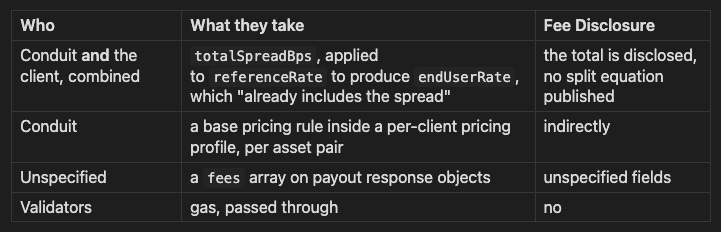
On Conduit’s $36M Series A announcement last year, they mentioned more than $10B in annualized payment volume, with operations across the US, LatAm, Europe, and Africa.
The key difference between Conduit and the two others is: ZeroHash and Bridge (under Stripe’s umbrella) operate with a full suite of licenses, fully compliant in the US and Europe. Whereas Conduit chose the rental path for its operations.
This is a move we have seen across other Stablecoin verticals, because of the time and cost that it requires (Bridge and zerohash are valued in multiple billions) smaller entities opt for a leaner partner-dependent strategy and focus on growth rather than owning the stack.
You can always go after the license later.
So who’s responsible for the fees?
The orchestrators and the consumer apps can compete against each other to shrink their portion of the fees. That’s how the free market works.
But what isn’t in their control is the FX fee.
You need four things to convert a dollar into pesos.
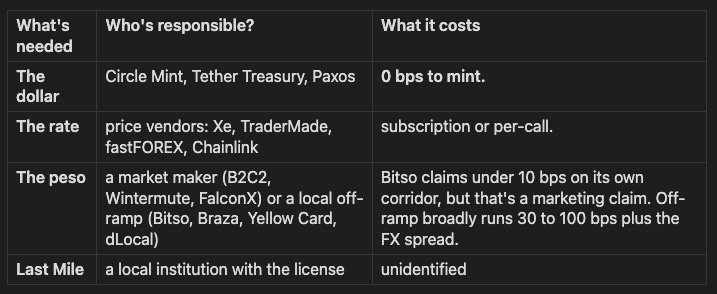
On top of that you have other service providers like Fireblocks payments network. Working-capital providers like Huma, who issue loans to fund the payment before the actual money arrives. It’s a neat way to get around the prefunding requirement.
The stablecoin leg is the cheapest part. The cost is disproportionately concentrated at the FX and exit leg, out of the blockchain’s reach.
It took me 2000 words to really explain that... despite having the ultimate technical solution, we’re still completely dependent on legacy fiat mechanisms to settle cross-border payments.
The stablecoin rail is only as cheap as the most expensive fiat component on the transaction flow. The same applies to settlement speed.
But remember, we’re testing the efficacy of the stablecoin rails in the most competitive corridor. Legacy rails have already compressed the fee structure to its limit and made the process as fast as the rails would allow. You need to fight for every basis point here.
But it isn’t the same everywhere else though. There are several high value corridors in the world where stablecoins can win outright both on fees and speed.
Corridors like US-India, US-Guatemala, US-Philippines present equally lucrative opportunities. You’ll find the same tradfi players competing there as well, but you get more of an opportunity to undercut the incumbents compared to US-Mexico.
Especially India is a standout corridor receiving nearly $40B every year from the US, $50B+ from the Gulf states, and around $15B from the UK.
Then there are corridors like Nigeria, Argentina, Turkey that suffer from a broken or restricted fiat exit. So much so that stablecoin p2p grey markets are a thriving business in these places already proving stablecoins’ efficacy and local demand.
The opportunity for stablecoin cross-border transactions isn’t contested anymore. I have mentioned in several of my writings that EM countries will present the most lucrative opportunities along with the hardest regulatory battles. Countries like India continue to present an adversarial outlook towards stablecoins and crypto as a whole. But I believe the size of the opportunity is worth a regulatory battle for institutions with deep pockets. But that’s a topic for another essay.
How I see the future
Stablecoin as a technology is so groundbreaking that for the first time in nearly half a century institutions are having to rethink the financial architecture.
Legacy platforms including banks and fintechs are aggressively considering adopting stablecoin rails. There is a short window (2 to 5 years in my estimates) for stablecoin native companies to establish themselves in this new financial order.
Consumer, orchestration, on/off ramp, FX are all places where we’ll see extreme competition over the next few years. More entities will chase a further shrinking margin with better products ultimately benefiting the end users.
Consider subscribing to newsletter.anvesan.org to read our latest research briefs, essays, and reports.